Ladies and gentlemen, by way of introduction, this is a story about trickery - and fraud. About lies. Tell it by the fireside or at the marketplace or in a movie, almost any kind of story is certainly some kind of lie. But not this time. No, this is a promise. Throughout this next piece, everything you hear from me is really true.
Isn't it bizarre we should think of plagiarism and forgery with the same kind scorn? Well they are both forms of deception I suppose, but in the exact inverse. A plagiarist wants you to believe that this really is his work - that they really are that good. A forger wants you to believe that their work is someone else's.
Did you ever hear the story of the great forger Han van Meegeren, who fooled the critics and scammed the nazis? He made his money in the early 20th century, painting fake Vermeers and selling them off to the happy rich folk of the lowlands. After the Second World War he became a national hero when it was revealed he had sold a fake Vermeer to Hermann Goring. The story goes that, when this was revealed to Goring, he looked as though he had first discovered evil in the world. What a story - but probably nothing more. There doesn't seem to be much evidence that Goring ever learned his Vermeer was a fake, not before he hanged at least, and Van Meegeren himself did very well for himself under Nazi rule, throwing extravagant parties in the stolen homes of Jews. So perhaps not such a happy story after all.
But there is a part of his story that is really true - that of Vermeers The Last Supper. When it was unearthed, critics lauded it as the greatest work of the artist, undiscovered up until now. And the truth? It was a Van Meegeren, an original composition in the style of Vermeer. So who was right in this case anyway, was it the painting or the critics? Is an original imitation worth any lauding? Is it even a fake? If men and women stood in front of that painting and found themselves moved, then why should it?
But there is a part of his story that is really true - Vermeers The Last Supper. When it was unearthed, critics lauded it as the greatest work of the artist, undiscovered up until now. And the truth? It was a Van Meegeren of course; an original composition in the style of Vermeer. So who was right in this case anyway, was it the painting or the critics? Is an original imitation worth any lauding? Should we think any less of it? If men and women stood in front of that painting and found themselves moved, then I don't see why we should.
Our works in stone, in paint, in print, are spared, some of them, for a few decades or a millennium or two, but everything must finally fall in war, or wear away into the ultimate and universal ash - the triumphs, the frauds, the treasures and the fakes. A fact of our life: we're going to die. "Be of good heart" cry the dead artists out of the living past. "Our songs will all be silenced, but what of it? Go on singing!" Maybe a man's name doesn't matter all that much.
Now an admission - I tried it in the confessional but my priest said I had to own up. For the above paragraphs I've plagiarised the voice of Orson Welles in his movie F for Fake. I've not the skill to be a forger, not yet at least, so this second-rate imitation is all you're getting. His film about Elmyr de Hory adapted to my writing about Van Meegeren, the first and sixth paragraphs even lifted wholesale, and my my how I hope you fell for it. And in this spirit of truthfulness, I suppose I should reveal my other inspirations, adaptations, imitations, and whatever else I've collaged across this website. If you prefer you can see it as a bibliography, but a fake with citations is still a fake.
The fireplace is taken from the Villa Terrace museum of decorative arts in Milwaukee, in what was once Mr & Mrs Lloyd and Agnes Smith's bedroom. The painting inside it is an Edvard Munch called At the Roulette Table in Monte Carlo. The name of the site, Bear it grinning, is inspired by the name of Imogen Binnie's old book-review blog: Keep Your Bridges Burning. Along the top you can read T.S. Elliot's The Lovesong of J Alfred Prufrock as it scrolls along. The rug is a 19th century Tibetan piece owned by the Newfields Museum in Indianapolis. The maker is unknown, as is typical of the poor unpretentious decorative artists, whose anonymous work adorns the floors of rich, beautiful, carefree people.
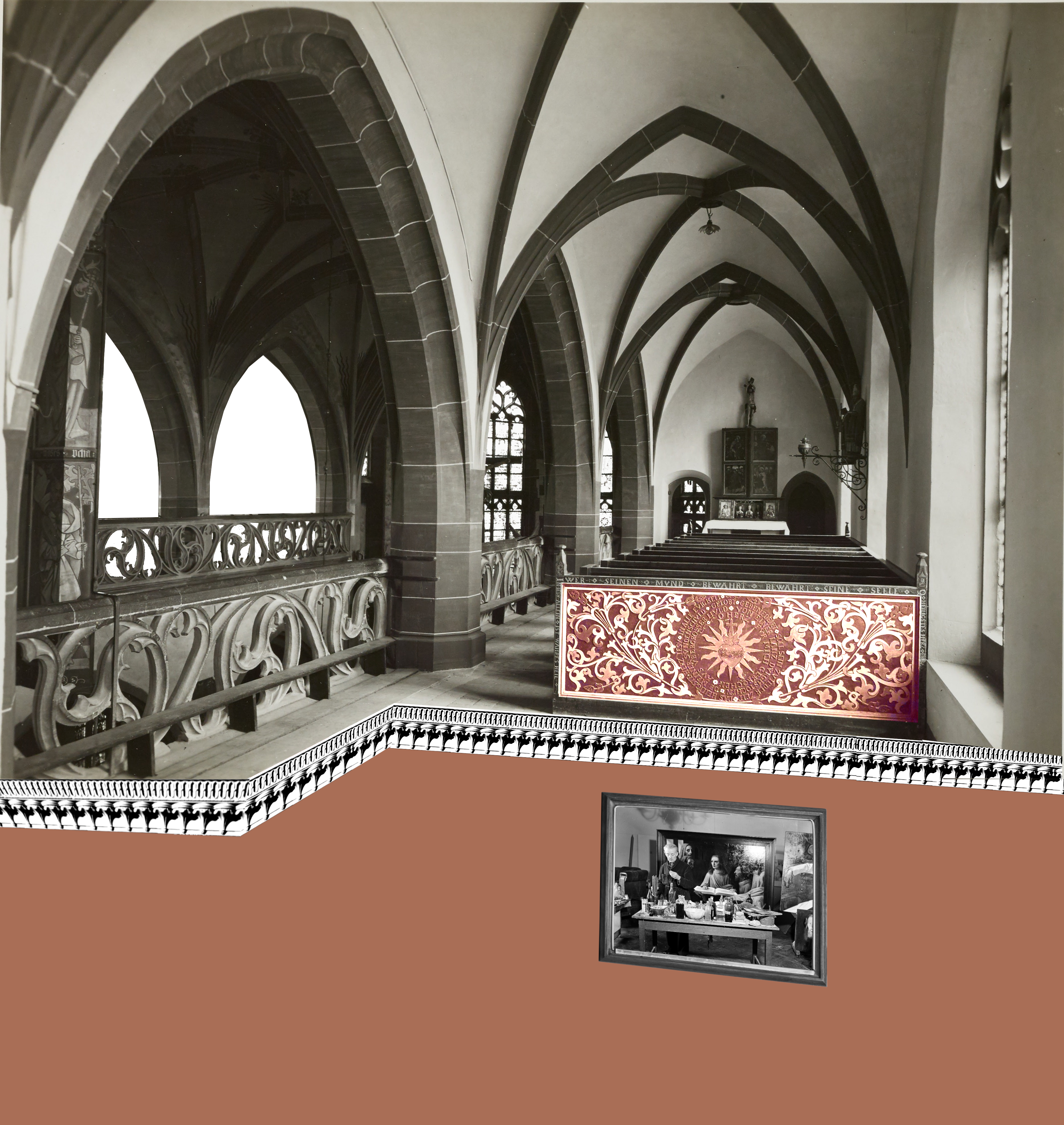
The church you see at the top is the Church of St. Valentine and St. Denis in Kiedrich. Again the makers are unknown. Through the church windows, and as a background to the page, you can see Elmyr de Hory's 'Beach at Trouville'. I've been unable to trace the neogothic cornice used as a border. The framed picture at the top of this page is a photograph of Van Meegeren taken by Koos Raucamp. He was charged with selling a Dutch national treasure to the Nazis, and claimed it was a forgery. In order to prove it, he was made to paint a Vermeer forgery under the watch of the state (as he can be seen doing in the photo). The text is inspired by Orson Welles' film F for Fake, as I said before, and the idea for a Bibliography of Plagiarisms is taken from Alasdair Gray's novel Lanark. Some of the information about Van Meegeren is taken from the writer and artist Jonathan Lopez.
The picture at the top depicts the Harrowing of Hell, and is taken from the Vaux Passional.